Minority Rejects Akosombo Fire as Cause of Ongoing ‘Dumsor’
Opposition insists power crisis predates substation incident, blames government for worsening outages
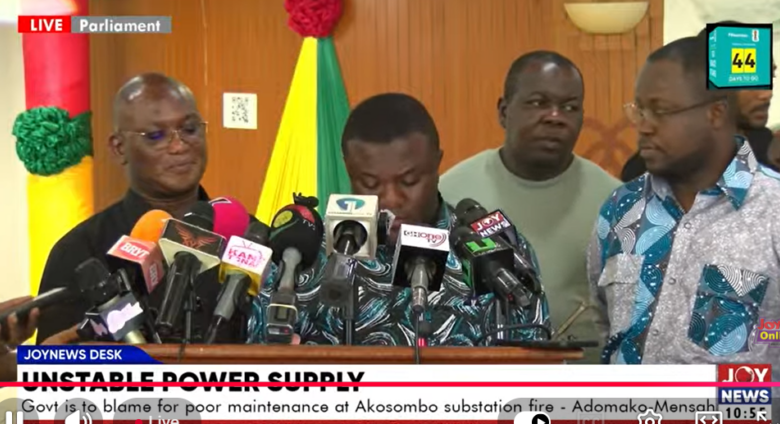
The Minority in Parliament has dismissed claims that the recent fire at the Akosombo substation is responsible for the ongoing power outages across parts of the country, arguing that the situation began months earlier.
Speaking at a press conference on Tuesday, April 28, the Deputy Ranking Member on Parliament’s Energy Committee, Collins Adomako-Mensah, maintained that the electricity challenges popularly known as “dumsor” had already been affecting Ghanaians well before the April 23 incident.
“Ghana’s power crisis, the dumsor that millions of Ghanaians have been enduring since January 25, was not caused by any accident at Akosombo. It was caused by this government,” he said.
Mr. Adomako-Mensah described the substation fire as a reflection of deeper systemic issues within the power sector.
“The events of 23rd April are the latest and most dramatic symptom of a power sector left to decay under the NDC’s incompetent stewardship,” he said.
He cautioned against linking the ongoing crisis solely to the Akosombo incident, insisting that such claims would distort the reality of the situation.
“The Mahama government must not be permitted to use this incident as a convenient alibi for a crisis that predates it by more than a year, and the Minority will not allow that cynical rewriting of history to pass unchallenged,” he added.
The Minority also presented a timeline of power outages, noting that frequent and unannounced disruptions had been experienced nationwide long before the substation fire.
“Long before the event of 23rd April 2026, Ghanaians across every region of this country had been enduring persistent, unannounced, and devastating power outages,” he said.
He further pointed to several emergency and maintenance notices issued by the Electricity Company of Ghana (ECG) in April, as well as public apologies from its leadership over unstable power supply and damage to electrical appliances.
According to him, the situation had already taken a toll on households, businesses, and essential services across the country.
“Communities were living in darkness, not for hours, but for days. Industries were hemorrhaging losses. Cold stores were warm. Hospitals were straining on generators,” he stated, adding that “that was the reality of Ghana’s power sector before any incident at Akosombo.”
He reiterated that these challenges existed prior to the Akosombo incident and should be considered when assessing the broader state of the country’s energy sector.